
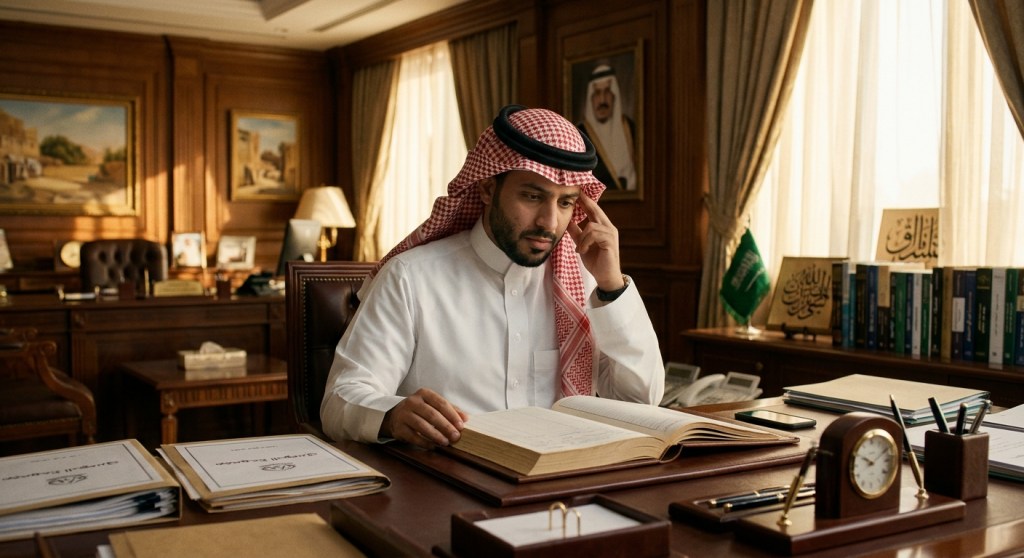
Khalid Al-Dosari was twenty-nine, with a master’s degree from a good university in the United States and almost no idea how to run the world that had just become his.
His family, we’ll call them the Al-Dosari family, had built a substantial industrial and contracting group in #Riyadh over two generations. His father, a formidable and private man, had kept the family’s personal affairs the way many self-made Gulf patriarchs do: entirely in his own hands, entirely in his own head. When his father suffered a stroke that left him unable to continue, Khalid, the eldest son, inherited not just a position but an entire operating reality he had never been taught to manage.
Three homes, the main compound in Riyadh’s Al Nakheel district, a house in Jeddah, and an apartment in Mayfair. A personal staff of more than twenty. His father’s drivers, his mother’s household, the family’s calendar of obligations, the weddings and funerals and majlis gatherings where a family’s standing is quietly maintained or quietly lost. And, hardest of all, a staff who had served his father for decades and who now watched the young man with the unspoken question every heir dreads: is he up to it?
Drowning in a quiet way
Khalid did what capable young people do. In the room, he said the right things. He attended the gatherings, he signed what was put in front of him, he maintained the composure expected of an Al-Dosari.
At night, he could not sleep. He told us, later, that in those first weeks he had genuinely no idea where to begin, that he would lie awake with a list in his head that only grew longer, terrified of making a visible mistake in front of staff who remembered when he was a boy. He was failing at something no one had ever shown him how to do, and he was failing it alone, because asking for help felt like admitting he couldn’t carry his father’s name.
A family advisor, watching him struggle, suggested he speak to us.
What we did
We did not arrive and take over. For a young principal, being managed by strangers would have confirmed exactly the doubt the staff already held. We did something more careful. We put a steady hand on the wheel while he learned to steer, and we made sure the household saw him succeed, not us.
First, we took the operational weight off him, the bills, the vendors, the logistics, the schedule, so that he wasn’t drowning in a hundred things his father had done invisibly. Relief first. A man who cannot sleep cannot learn.
Then we brought structure where his father had kept only instinct. We built simple, clear systems Khalid could actually understand: who does what, how the homes run, what needs his decision and what does not. For the first time, the thing he’d inherited had a shape he could see.
We managed the staff through the transition with great care. The drivers, the housekeepers, the people who had quietly doubted him, we gave them a household that ran impeccably, and we made sure the credit landed where it mattered: with the young principal they served. When a home runs beautifully, authority settles quietly, without anyone having to assert it. Within months, the doubt in that household had simply evaporated. Khalid had not demanded respect. He had earned it, with our support behind the scenes.
And then we did the most important thing, the thing that separates a good private office from a crutch. We began to hand it back. Piece by piece, as he grew into it. We taught him what to care about and what to delegate. How to read a household. How to lead people older than himself. How to carry his father’s name in rooms where it mattered.
What happened
A year after that first sleepless month, Khalid was not a young man clinging to a role too big for him. He was a principal, confident, capable, in command of his family’s world, and quietly running it better than it had ever been run, because for the first time it had structure beneath the instinct.
His father recovered enough to see it. Near the end of that year, the old man told a family member something that got back to us, and that we hold as one of the truest measures of our work: that he had been more worried about whether his son could carry the family than about his own health, and that he could now rest.
Khalid still works with us. But the relationship has changed. He no longer needs a hand on the wheel. He has a partner he trusts, which is a very different and much better thing.
The lesson underneath
The next generation rarely fails for lack of ability. Khalid was clever, serious, and willing. He failed, at first, for the reason most heirs do: he inherited a world built entirely on one person’s instinct, with no structure, no handover, and no one in his corner during the single hardest transition of his life.
Preparation is everything. And it is almost never done in time, because the generation in charge cannot imagine not being in charge.
How Gulf Prestige Lifestyle helps
We are the bridge between generations. We hold the operation steady during a handover, build the structure a young principal needs to succeed rather than merely survive, and, crucially, we hand it back as they grow, so that we create a capable leader, not a dependency. The goal is always a next generation that can stand on its own.
The last word
Wealth passes down in an instant. The ability to carry it does not. The families that endure across generations are the ones who make sure the next one is caught, taught, and then trusted, in that order.
If you are thinking about the generation that comes after you, speak with us in confidence at privateoffice@gulfprestigelifestyle.com
Whatsapp : +96895851211


Leave a Reply